
On the production floor of Cork Plastics Ltd in Ireland, Extruder Line 29 — a heavy-duty Scheider plastic extrusion machine — ran day in and day out. Responsible for high-throughput plastic moulding, its gearbox and bearing system relied on a 60-liter sump of heavy Shell Omala 320 gear oil.
To the naked eye, the machine seemed to be running as expected. But inside the gearbox, microscopic contaminants were quietly shortening the life of critical components.
The Red Flag: Oil So Dirty It Couldn’t Be Counted
When Technical Manager Mark O'Mahoney and Maintenance Engineer Pete Davis pulled an oil sample to evaluate cleanliness, the laboratory findings revealed severe contamination:
Particle Count: N.C. ("Not Countable") — the concentration of solid debris was so dense the analysis equipment could not register an accurate count.
Estimated Cleanliness: An alarming ISO 22/18/15.
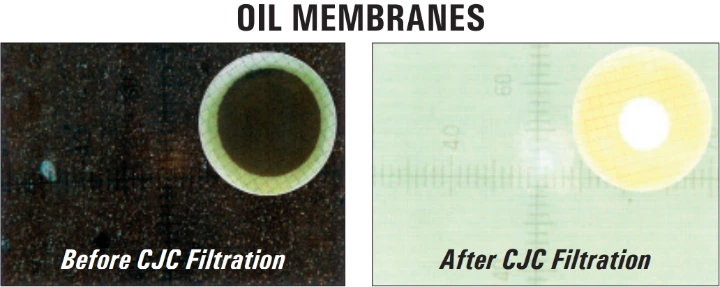
Varnish & Oxidation: The analysis membrane patch turned a dark, murky brown, indicating high levels of varnish and oil degradation.
Moisture: Water content measured at 150 ppm.
Varnish, moisture, and abrasive micro-particles create a harsh environment for bearings. Left unchecked, this contamination leads to accelerated friction, premature bearing fatigue, micro-pitting, unexpected downtime, and costly gearbox overhauls.
The Intervention: Kidney-Loop Offline Filtration
Instead of relying solely on standard inline strainers or scheduling frequent full oil dumps, Cork Plastics partnered with CJC™ (C.C.JENSEN).
They installed a CJC™ HDU 15/25 PV Fine Filter running in a continuous kidney-loop with a flow rate of 30 L/h, fitted with BG 15/25 filter inserts. The objective was simple: continuously strip out solid particulate, capture oxidation residues (varnish), and extract dissolved and free water.
The Journey: The 7-Month Turnaround
Over a 7-month evaluation, the maintenance team monitored the oil's recovery:
Metric | Baseline (Oct 2005) | After 2.5 Months (Jan 2006) | System Desorption (Feb 2006) | Final Target (May 2006) |
|---|---|---|---|---|
ISO 4406 Cleanliness | 22/18/15 (est.) | 17/16/12 | 18/17/12 | 13/11/8 |
Membrane Patch Color | Dark Brown (Varnish) | Light Brown | White | Pure White |
Water Content | 150 ppm | 69 ppm | 17 ppm | 33 ppm |
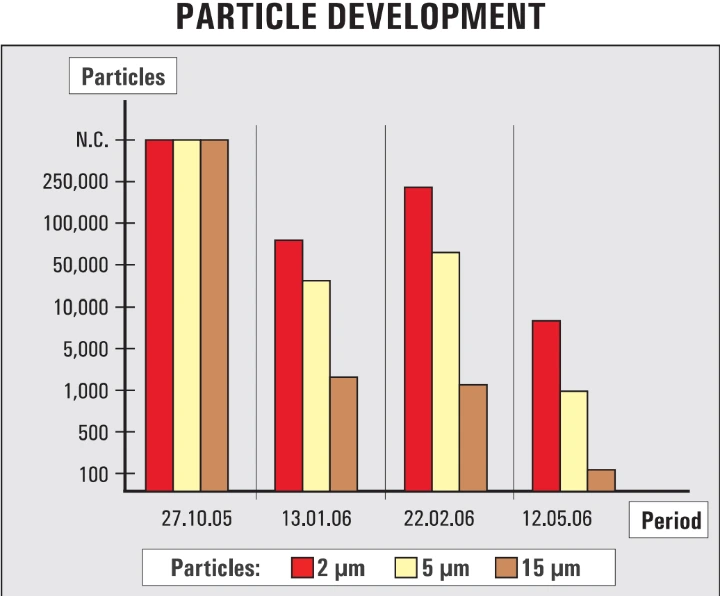
2 µm Particles | N.C. | 84,656 | 231,620 | 7,054 |
5 µm Particles | N.C. | 32,480 | 68,194 | 1,924 |
15 µm Particles | N.C. | 2,312 | 2,035 | 143 |
The System Cleanout Phenomenon
Notice the temporary spike in particle counts between January and February 2006. As the offline filter brought the bulk fluid to pristine condition, the super-clean oil began acting as a flushing agent—dissolving and dislodging trapped varnish and settled particulates from the internal pipe walls, bearings, and gearbox housing. Once these internal surfaces were fully purged, the fine filter captured the freed debris, driving the system to an ultra-pure ISO 13/11/8.
The Big Win: Extending Bearing Life by a Factor of 6
The most critical outcome of this filtration upgrade was the operational impact on the machine's mechanical components:
Diagnostic projections confirmed a Bearing Life Extension Factor of 6.
By eliminating destructive 2–15 µm silt, removing abrasive wear particles, reducing water down to 33 ppm, and clearing out varnish residues, the mechanical stress on the extruder bearings was substantially reduced:
600% Longer Component Life: Operating with oil at ISO 13/11/8 instead of 22/18/15 allows bearings to run up to six times longer before reaching fatigue limits.
Elimination of Unplanned Shutdowns: Protecting the gearbox from sudden bearing failure keeps extrusion lines operational and predictable.
Maximized Oil Longevity: Removing water and oxidation by-products prevents premature fluid breakdown, reducing waste oil disposal and replacement costs.
Key Takeaway for Plant Maintenance Teams
Oil contamination is often an unseen threat until equipment failure occurs. By shifting from reactive oil changes to continuous offline depth filtration, Cork Plastics transformed severely contaminated gear oil into a clean fluid environment, securing a 6x extension in bearing lifespan on their production line.