
In Malaysia’s industrial and marine sectors, diesel fuel polishers are essential for ensuring clean, efficient operations. Contaminated fuel can lead to many operational and maintenance problems to engines/machineries and its whole operations. This article explores how fuel can be contaminated and consequences, how fuel polishers work, their benefits, and why companies in Malaysia trust leading providers like EPS for their fuel polishing needs.
How Diesel Fuel Get Contaminated
Diesel fuel contamination is a critical issue that can severely damage injection systems, clog filters, and cause engine failure. Contamination typically happens through a combination of environmental factors, poor storage hygiene, and the chemical nature of modern diesel itself.
Here is a condensed breakdown of how diesel gets contaminated:
Water Contaminations: water enters tanks through three main routes
- Tank "Breathing" - daily temperature swings cause air to move in and out of storage tanks. Moisture from this air condenses on the cold, empty upper walls and drops into the fuel.
- External Ingress - rainwater or wash-down water leaks through faulty tank seals, degraded cap gaskets, or unsealed vents. Sometimes diesel fuel supplied already contained some water.
- Temperature Drops - diesel naturally holds a small amount of dissolved water. When temperature drops, this moisture separates out into harmful free water.
Particulate Contamination (Dirt & Rust) - solid particles enter the fuel during handling or form inside the system
- Environmental Dust - airborne dirt and silica enter through unprotected tank vents during fuel transfers.
- Internal Rust & Scale - internal water causes steel tanks to rust, shedding abrasive iron oxide particles into the fuel.
- Asphaltenes - under the high heat and pressure of modern injection systems, fuel components can chemically degrade, forming sticky, black, tar-like solids.
The "Diesel Bug" (Microbial Growth): the "diesel bug" refers to bacteria, yeast, and fungi that breed inside fuel tanks.
- The Fuel-Water Interface - microbes require water to live and diesel to eat. They thrive exactly at the boundary line where the floating diesel meets the settled water at the bottom of a tank.
- The Biodiesel Factor - modern diesel blended with biodiesel (FAME) is highly hygroscopic (attracts water) and biodegradable, providing the perfect breeding ground and nutrient source for these organisms.
These contaminants accelerate each other: Water triggers microbial growth, which creates acids, leading to tank corrosion and particulate debris. Keeping fuel clean requires strict tank hygiene, moisture control, and dedicated offline filtration to remove water and fine solids before they reach the engine.
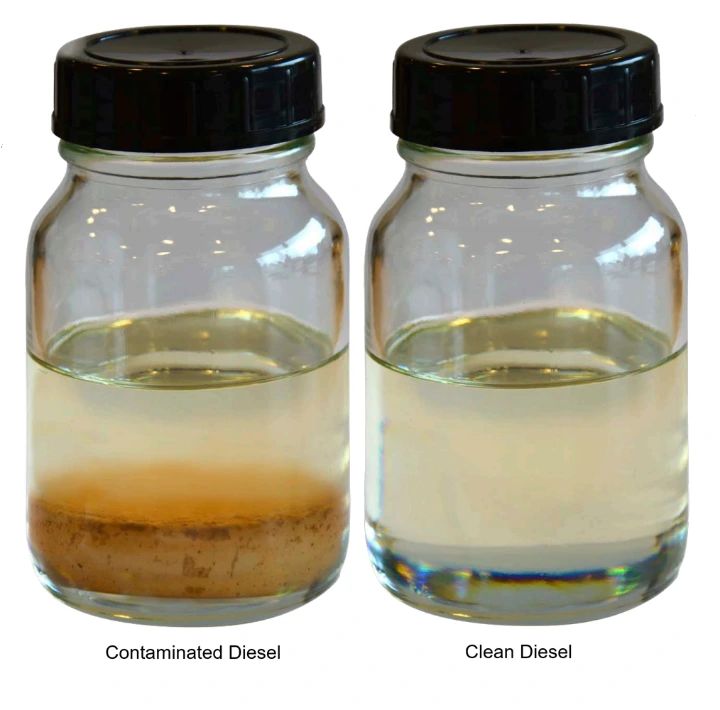
Damaging Consequences of Contaminated Diesel
Contaminated diesel severely impacts engine performance and can cause catastrophic mechanical failure. When water, particulates, or diesel bug get into the fuel, the consequences ripple through the entire fuel delivery system.
Here is a breakdown of the damaging consequences, how it affects performance, and when the fuel becomes a total loss.
Damaged Injection Systems & Fuel Pumps - modern diesel engines rely on High-Pressure Common Rail (HPCR) systems operating at extreme pressures. These components have clearances as tight as 1 to 2 microns and rely on the diesel fuel itself for lubrication.
- Abrasive Wear: Fine particles (silica, rust) act like sandpaper, scoring the tight tolerances of fuel pumps and injector needles.
- Component Erosion: When water reaches the injector tip, the extreme heat and pressure cause the water to flash-boil into steam. This localized "explosion" literally erodes the metal of the injector nozzle.
- Sticking Components: The slimy biomass from diesel bug or sticky asphaltene tar can cause injector needles to seize or stick open, leading to uncontrolled fuel delivery.
Impact on Engine Performance - contaminated diesel directly degrades how an engine runs. You will typically notice:
- Loss of Power and RPM: Clogged fuel filters restrict fuel flow, starving the engine. The engine may struggle under load or fail to reach its rated RPM.
- Rough Idling and Misfires: Damaged or partially blocked injectors fail to atomize the fuel into a fine mist. This causes incomplete combustion, resulting in a rough idle, engine knocking, or misfiring.
- Excessive Smoke Emissions: Poor combustion creates visible exhaust issues. Black smoke indicates unburnt fuel (often from a dripping or worn injector), while white smoke can indicate water vapor passing through the combustion chamber.
- Increased Fuel Consumption: When combustion efficiency drops, the engine control unit (ECU) or the operator must inject more fuel to achieve the same power output.
Filter Blinding and Fuel Starvation - Fuel filters are your first line of defense, but contamination quickly overwhelms them.
- Rapid Plugging: Diesel bug sludge and asphaltenes form a thick, gooey layer over filter media. Instead of lasting hundreds of hours, filters can plug up within minutes or hours of replacement.
- Filter Collapse: If the fuel pump continues to pull suction against a completely blinded filter, the high differential pressure can cause the filter element to collapse internally, dumping a massive wave of concentrated contaminants straight into the engine.
Is there a possibility that diesel needs to be disposed?
Yes, but it is usually a last resort. Fuel disposal is costly and environmentally heavily regulated. In most cases, fuel can be salvaged, but there are specific scenarios where disposal is unavoidable. You will likely have to dispose of the fuel under the following conditions:
Severe Chemical Degradation (Age)
High Total Acid Number (TAN):
Cross-Contamination:
Heavily Contaminated:
The ultimate rule of thumb is to continuously fuel polishing which can prevent contamination from ever taking root, preserving both fuel chemistry and system integrity.
How Fuel Polishers Work
Fuel oil polisher operate by removing water, sediments, and other impurities from diesel fuel oil. Using fine filtration and water removal fuel polisher, ensure the removal of both water and visible and microscopic contaminants. EPS offers advanced systems designed for continuous operation, ensuring consistent polishing and purification under harsh conditions.
Using high-quality polishers or purifiers bring a lot of benefits. According to a 2023 industry report, companies that use advanced fuel polishing or purification systems see up to 30% reduction in fuel-related maintenance costs. This makes investing in a reliable purifier not just an operational improvement but a strategic advantage.