Table of Contents
In the world of critical machinery, oil is the lifeblood. You know regular maintenance is essential, and you likely rely on your machine’s built-in, or “in-line,” filters. But if you want to achieve total oil cleanliness—the level that dramatically extends component life and cuts maintenance costs—you need to look beyond the basic circulation system.
The secret? Offline Filtration using dedicated offline filters.
Here is why offline filters, or “kidney loop,” filtration is absolutely crucial for achieving and maintaining maximum oil cleanliness.
Why In-Line Filters Aren't Enough
Inline filters are essential; they are the first line of defense, designed to protect sensitive components from large, catastrophic particles during operation. However, they have inherent limitations that prevent them from delivering the level of purity modern machinery demands:
1. Limited Fineness: In-line filters must handle high system flow and pressure. To prevent the filter from starving the system or causing major pressure drops, their filter media is often coarser (e.g., 10-25 micron nominal). Unfortunately, the most abrasive and damaging wear particles are typically in the 2 to 7 micron range—the size of the clearances in critical components like servo valves and bearings. These are the particles that slip right through standard in-line filters.
2. Pressure Surges: Start-up, shut-down, and operational pressure spikes can subject in-line filters to shocks, potentially forcing contaminants through the filter media or even damaging the element itself.
3. Low Dirt-Holding Capacity: Due to their size and design constraints, in-line filters often have a lower capacity for retaining contaminants, requiring frequent, costly replacement.
4. No Water or Varnish Removal: Most standard in-line filters are designed only for particle removal. They do not effectively remove water (which causes corrosion and oil degradation) or the oxidation by-products known as varnish (which causes sticking, sludge, and heat exchanger issues).
The Critical Role of Offline Filtration / Offline Filters
Offline filtration systems are standalone units that operate independently of the main machine circuit. They continuously “polish” the oil, bypassing the flow and pressure constraints of the main system. This independent operation allows for a truly transformative cleaning process:
- Ultra-Fine Filtration: Because the flow rate is slow and constant (a “kidney loop”), offline filters can use depth filter media to achieve absolute filtration down to 3 microns or finer. This removes the critical, wear-causing particles that in-line filters miss, drastically reducing abrasive wear.
- Water and Varnish Control: High-performance offline filters are designed to tackle all three major contaminants: particles, water, and varnish. By removing water and the soft contaminants that lead to oxidation, they protect the oil’s additive package and prevent the root cause of acid formation and oil degradation.
- Continuous Cleaning: An offline system can run 24/7, even when the machine is shut down. This ensures the oil is always clean and dry, preventing “roll-off contamination” from new oil drums and cleaning up the reservoir before start-up.
- Extended Component & Oil Life: By removing the contaminants responsible for up to 80% of oil-related failures, offline filtration extends the life of wear components (pumps, bearings, valves) by 2 to 10 times and can significantly prolong oil drain intervals—turning oil changes into an optional maintenance activity rather than a necessity.
Introducing CJC® Offline Filters: The Standard for Total Oil Cleanliness
When it comes to achieving unparalleled oil cleanliness, CJC® Offline Filters (manufactured by C.C. JENSEN) stand out as a global leader, specializing in deep-cleaning technology that goes far beyond surface-level filtration.
CJC® Technology: The Total Contamination Solution
CJC® Offline Filters are engineered as total contamination control units, tackling all forms of fluid degradation:
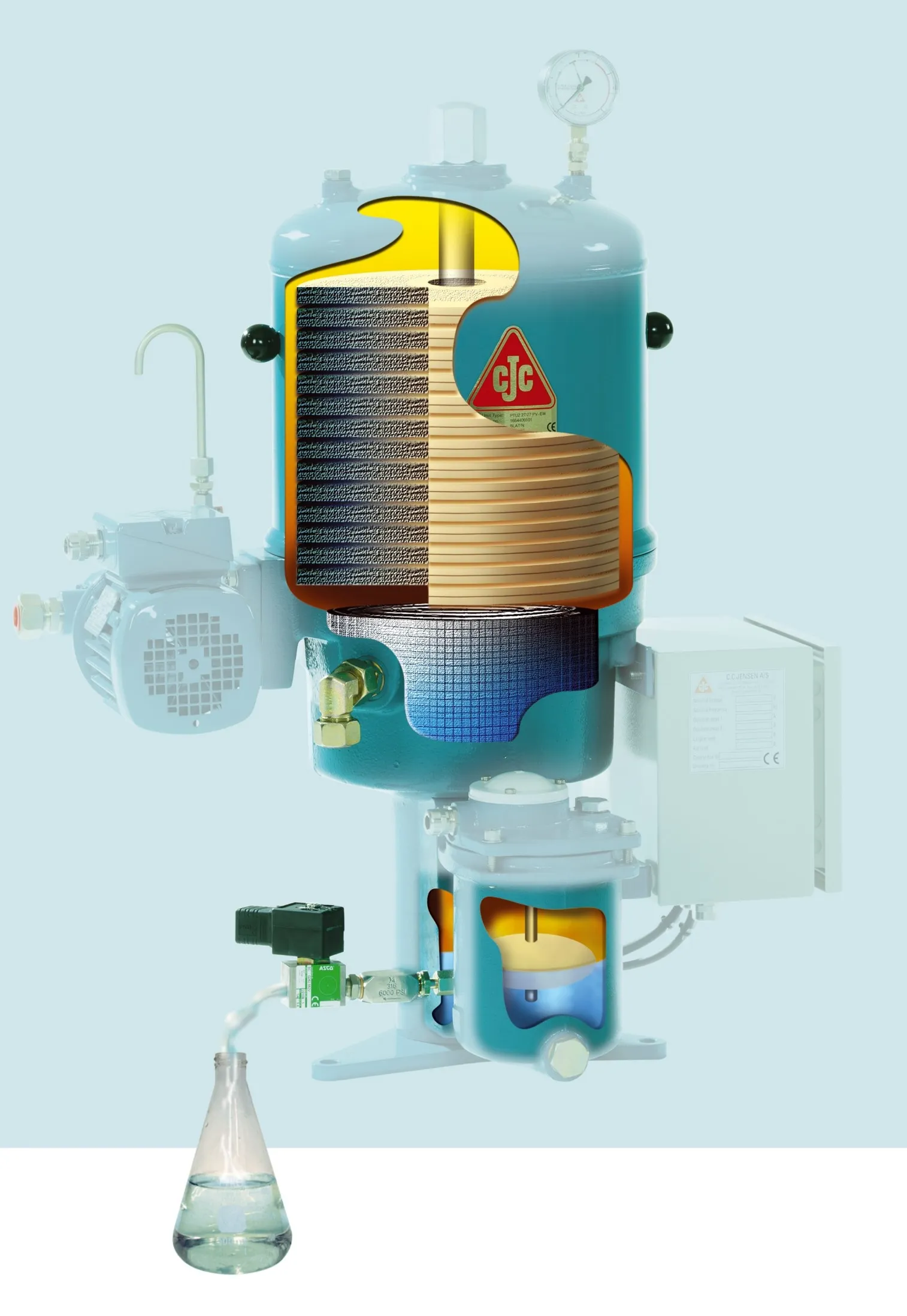
- Absolute Depth Filtration (3 m Absolute): CJC® utilizes unique, natural cellulose-fiber depth filter inserts. Unlike pleated surface filters, this construction forces the oil to travel through a dense matrix of fibers, effectively trapping particles down to 3 microns absolute (and even finer particles nominally). This is the key to removing the most critical wear-causing silt particles.
- Massive Dirt and Water-Holding Capacity: The depth filter design provides an enormous surface area. A single CJC® filter insert can hold up to 4 kg of solid particles and several liters of water, leading to incredibly long filter life and the lowest cost per kilo of contamination removed in the industry.
- Water and Varnish Removal in One Unit: CJC® filters are uniquely capable of removing both solid particles and oil degradation products (sludge/varnish) through adsorption into the cellulose fibers. For applications with high water ingress, models like the CJC® Filter Separator (PTU) use coalescing technology to continuously and highly efficiently separate free and emulsified water.
By continuously removing solid particles, water, and varnish, CJC® Offline Filters ensure your oil remains cleaner than new, providing maximum wear protection for your critical machinery.
The Bottom Line: An Investment in Reliability
Offline filtration isn’t an added cost—it’s a critical investment in asset reliability. By installing a high-performance system like the CJC® Offline Filter, you are:
- Maximizing Uptime: Reducing unscheduled breakdowns and downtime.
- Slashing Maintenance Costs: Extending the life of your oil, components, and even your existing in-line filters.
- Boosting Efficiency: Ensuring peak performance and reducing friction-related energy waste.
Don’t settle for “clean enough.” Make the switch to total oil cleanliness with offline filtration and secure the longevity and reliability of your most valuable assets.